The Close-up Photographer of the Year just proved that beauty doesn’t always play nice. The CUPOTY Challenge: Death & Decay is raw, haunting, and weirdly mesmerizing, pulling viewers straight into nature’s unfiltered reality where life and loss collide.
Taking the top spot is Willem Kruger, whose jaw-dropping image Hyena Portrait Zebra hits like a punch to the chest. Shot in Kruger National Park, the frame captures a spotted hyena gripping a severed zebra head. It’s intense, no doubt, but also honest. In the wild, nothing goes to waste, and Kruger’s shot leans straight into that truth without blinking.
Second place goes to Juan Jesus Gonzalez Ahumada, who delivers a quiet emotional gut-check with a male toad holding onto a dead female. It’s less graphic, more poetic, but just as heavy. Meanwhile, Gaël Modrak secures third with an eerie underwater image of a lifeless waterfowl chick, floating in stillness as time itself paused.
Launched in 2018, CUPOTY has built a rep as the go-to stage for macro and close-up storytelling. And this challenge? It flips the script. Instead of chasing perfection, it embraces the cycle of decay as transformation, endings as beginnings.
Bottom line: these images aren’t just seen, they’re felt. They remind us that nature doesn’t sugarcoat anything. It’s gritty, real, and strangely beautiful when you look close enough.
You can find more info:
1. Winner: « Hyena Portrait Zebra » by Willem Kruger, South Africa
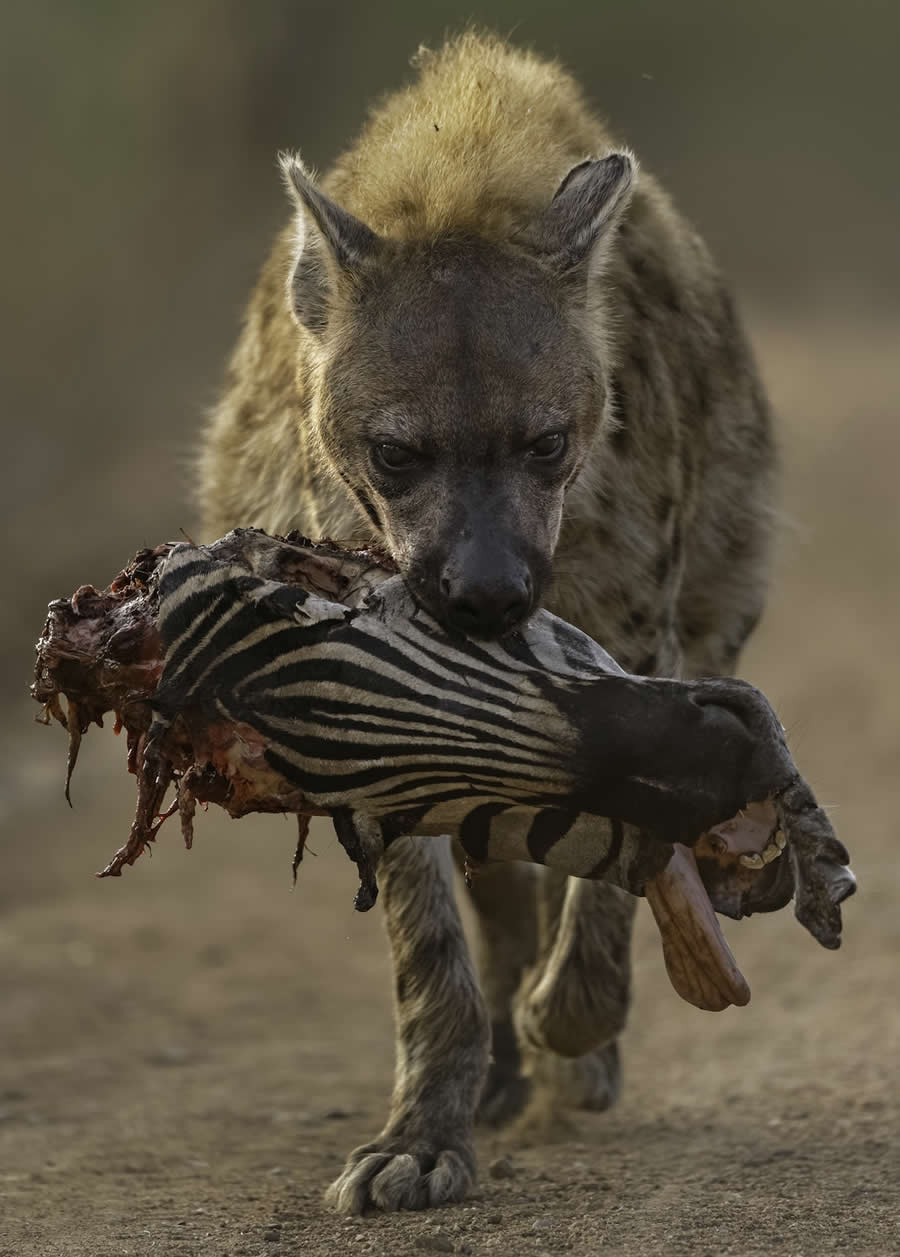
« A spotted hyena carries the head of a zebra through Kruger National Park, South Africa. Early one morning during a game drive in Kruger National Park, South Africa, my wife and I came across three spotted hyenas walking along the road. One was carrying the head of a zebra, presumably from a nearby lion kill, and was heading straight towards us. We parked at the roadside as the hyena approached and walked past our vehicle. We followed for a while, hoping it would lead us to the den. After a short distance, the hyena left the road and melted into the bush. In nature, almost nothing goes to waste – even hyenas have a family to feed, and they do it with remarkable commitment. »
2. 2nd Place Winner: « True Love » by Juan Jesus Gonzalez Ahumada, Spain
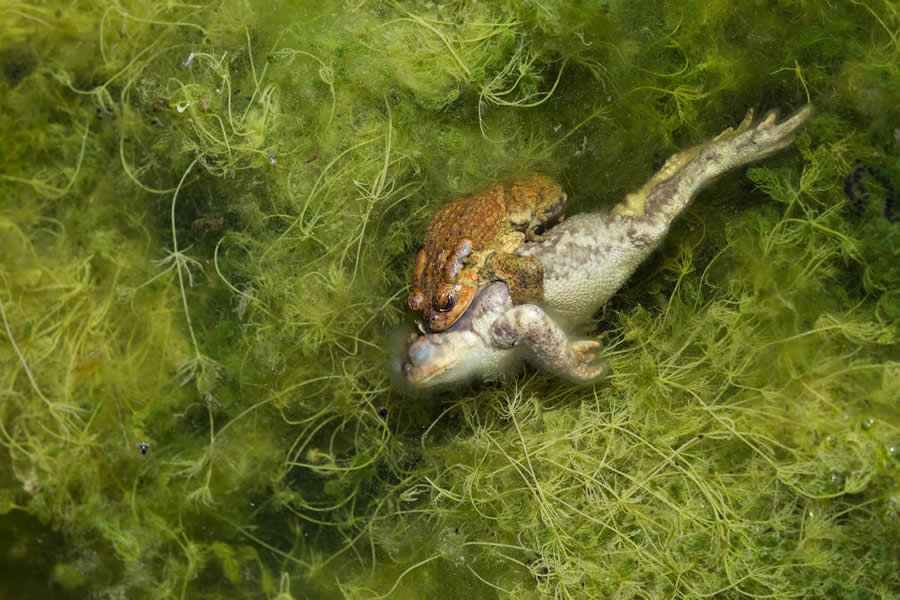
« A common toad performs amplexus on a dead female in a pool in the Sierra Blanca natural area, southern Spain. When the breeding season arrives, common toads congregate in ponds to mate. Often, several males court a single female, and sometimes she can die from suffocation, unable to surface for air amidst the throng of males surrounding her. In this case, several males had courted the female unsuccessfully and when tragedy struck, they all abandoned the scene. Only he remained, embracing her body – his true love. »
3. 3rd Place Winner: « Dead Chick of the Pond » by Gaël Modrak, France
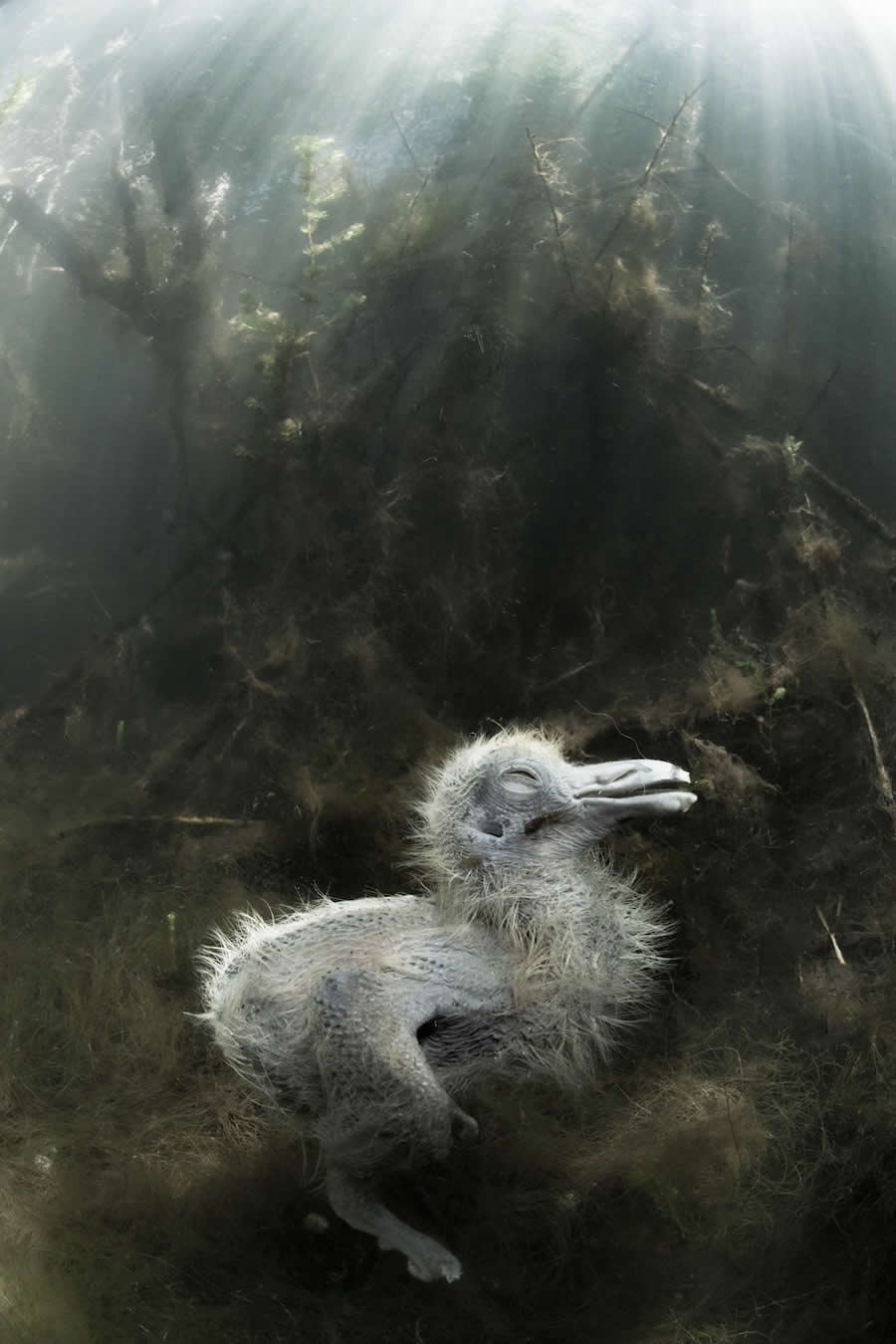
« A dead waterfowl chick lying underwater in a pond in Viry-Châtillon, near Paris, France. We were diving in a pond near Paris, and I was searching for interesting subjects in this rather barren setting when I discovered the body of a waterfowl chick lying on the bottom. The scene, though macabre, inspired me. I switched to my wide-angle lens to capture the sombre atmosphere, positioning myself to incorporate rays of light filtering down through the murky water, lending a mystical, almost reverential quality to the image. »
4. Finalist: « The Fly Wing Trophy » by G Ramaprasad, India
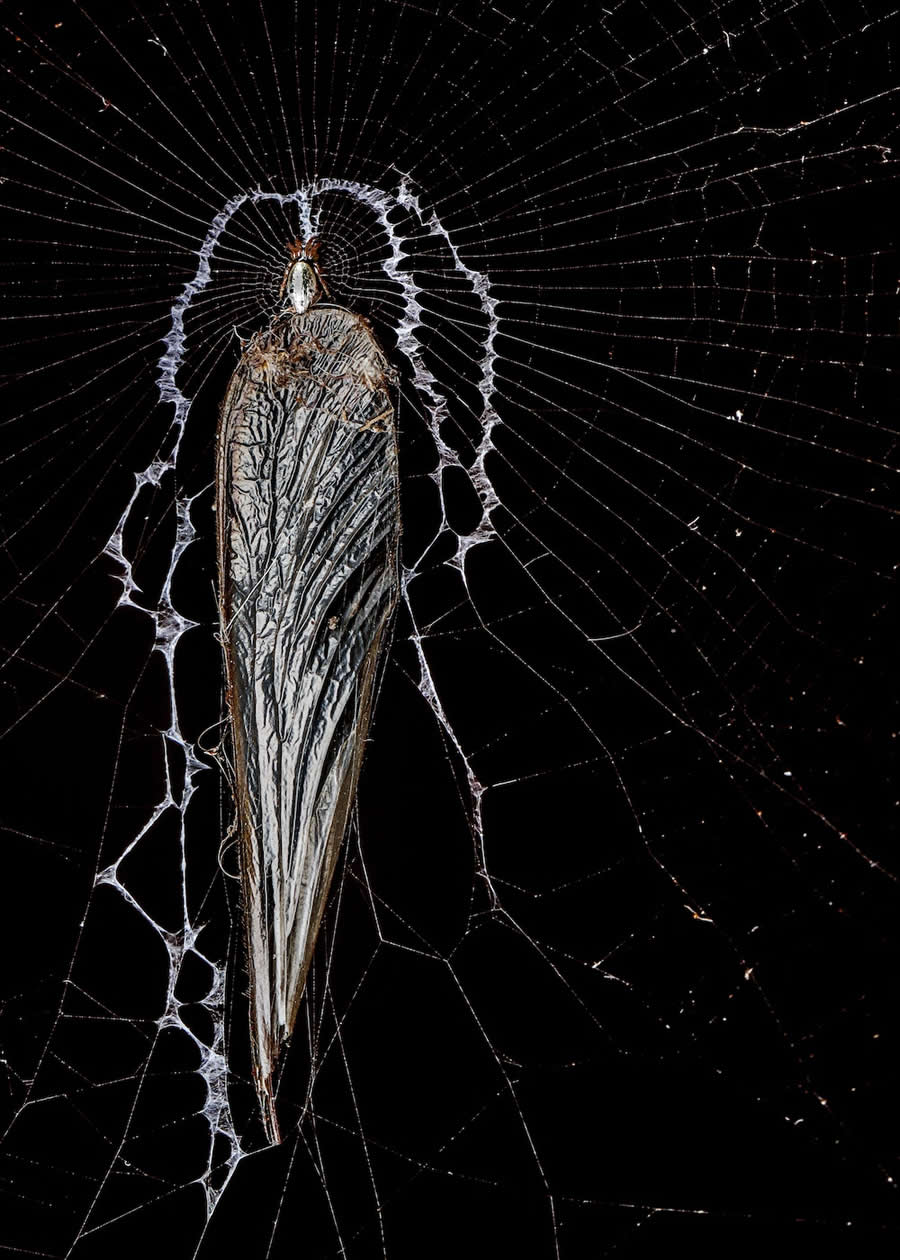
« A trashline orb weaver spider with the wing of a fly incorporated into its web, photographed in Honnavar, Karnataka, India. During a dry summer afternoon, while exploring my backyard in search of interesting insects to photograph, I came across a fascinating trashline orb weaver spider. These spiders have always captivated me with their intricate and uniquely designed webs. This particular encounter was especially striking – the spider had incorporated the delicate wing of a fly into its web, almost as if it were a trophy from a recent hunt. The scene felt like a natural work of art, showcasing both beauty and predation in perfect harmony. »
5. Finalist: « A Warning from the Wild » by Alex Pansier, Netherlands
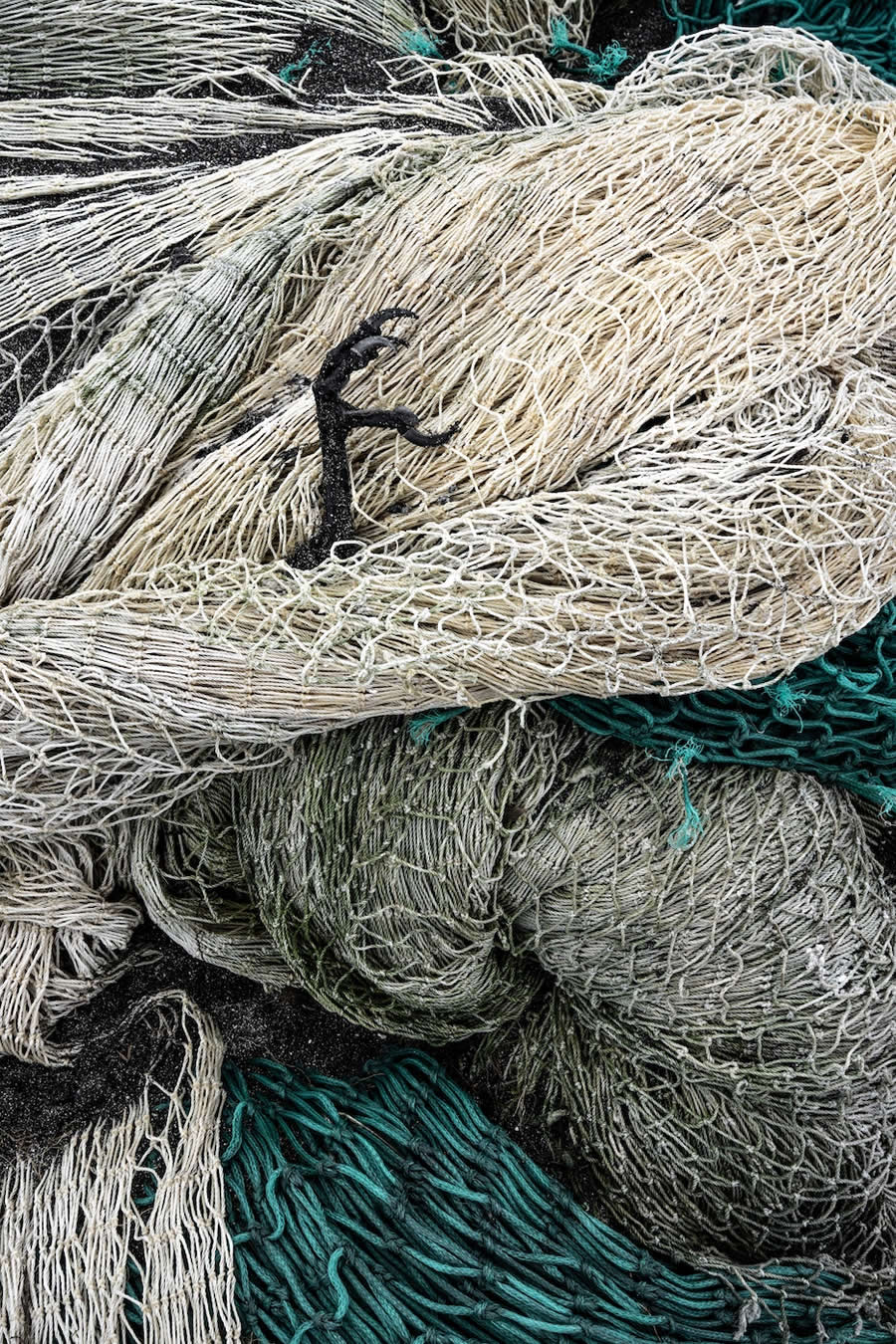
« The foot of a crow emerging from a pile of discarded fishing nets in Iceland. I was photographing the structures and textures of old fishing nets in Iceland when I noticed a crow’s foot emerging from the tangled ropes. At first glance, the scene appeared as an abstract composition of lines and patterns, but the dark claw revealed a more unsettling detail. The contrast between the sharp black foot and the pale woven nets transforms the image from a study of texture into a subtle reminder of how wildlife and human activity intersect in unexpected ways. »
6. Finalist: « Bee Meal » by Pete Burford, UK
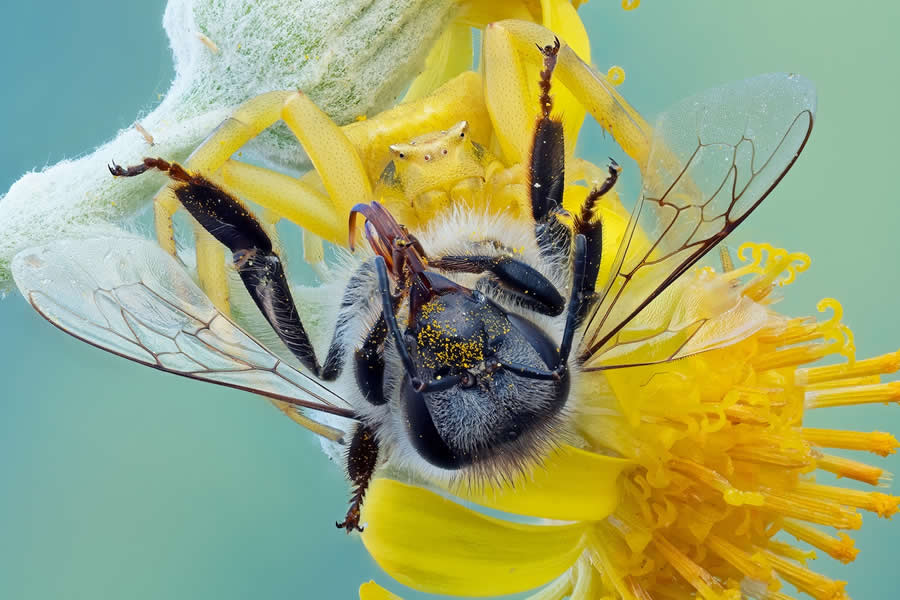
« A flower crab spider (Thomisus onustus) feeding on a bee on a flower in Crete, Greece. Near the beach by my hotel in Crete, I discovered a cluster of flowers inhabited by several flower crab spiders. These spiders can change colour to match their surroundings, and bees were constantly visiting the flowers for nectar, giving the spiders the perfect opportunity to ambush any that ventured too close. »
7. Finalist: « Eyed Food » by Emanuele Biggi, Italy
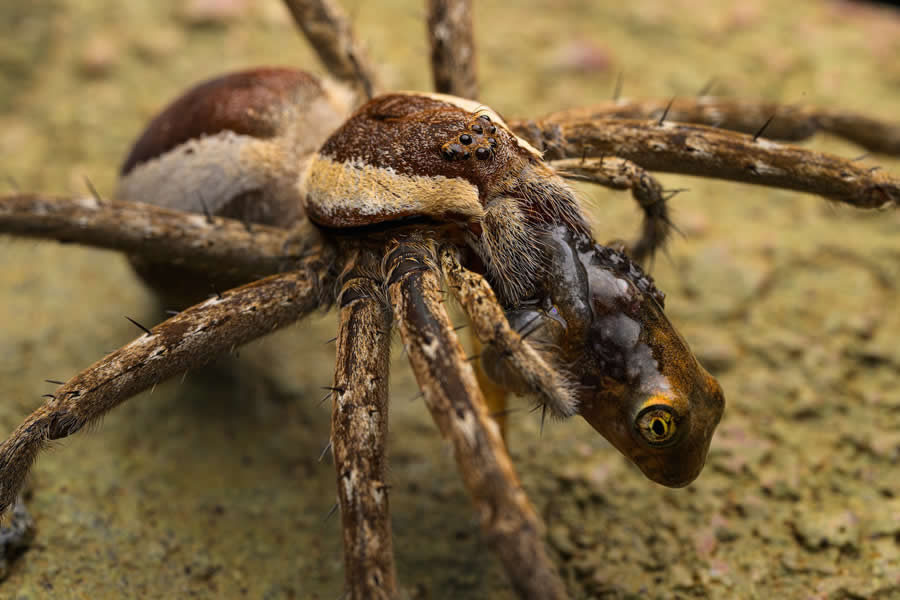
« A fishing spider (Nilus sp.) feeding on a freshly caught froglet on Nosy Komba island, Madagascar. I was photographing tadpoles and froglets around a shallow stream pool on the island of Nosy Komba, Madagascar when I caught a rapid movement out of the corner of my eye. I turned to see this large fishing spider (Nilus sp.) clutching a freshly caught froglet. I began shooting this tiny but dramatic scene of predation in the middle of the Malagasy forest. The spider fed from the back of its prey, so the lifeless eye of the froglet remained visible almost to the end of the feast. »
8. Finalist: « Feathers in the Wind » by Jason Gilbody, USA
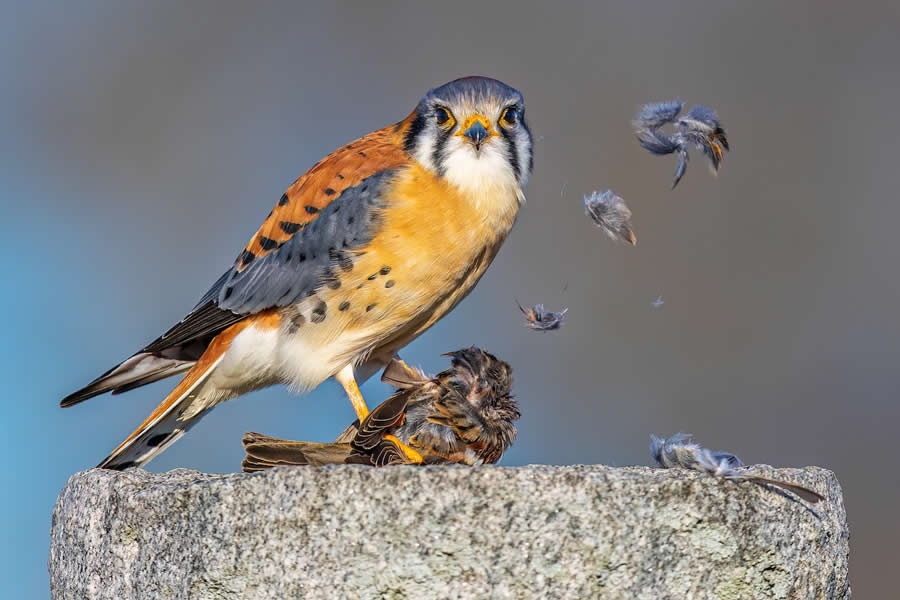
« An American kestrel plucking a sparrow on top of a gravestone in a cemetery in Massachusetts, USA. This American kestrel and its family reside in a local cemetery in Massachusetts. It habitually hides its prey in the flower pots placed at the gravestones. On this occasion, the kestrel pulled a sparrow from one of those pots and brought it to a nearby gravestone to feed. It was a windy day, so as it plucked the sparrow, the feathers floated away in the breeze, a fleeting, almost poetic scene set against the stillness of the cemetery. »
9. Finalist: « Crazed Paint » by Martin Malies, UK
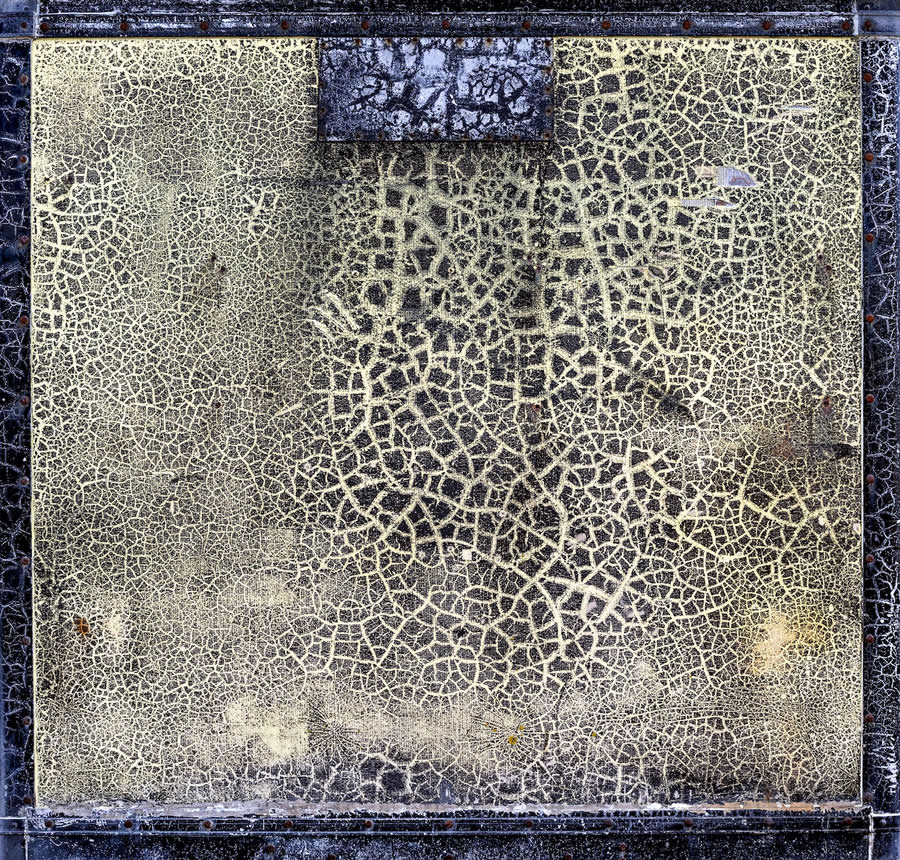
« Peeling, cracked paintwork on an abandoned shipping container on Dungeness Beach, Kent. This is part of an abandoned shipping container on Dungeness Beach, Kent. I was fascinated by the chaotic, abstract patterns of the dilapidated paintwork, which were conveniently and very effectively framed by the dark metal edges of the container. The cracked and peeling surface had taken on a life of its own, with layers of colour and texture that felt more like an abstract expressionist painting than the side of a rusting box. »
10. Finalist: « The Grip of Winter » by David Silsbee, USA
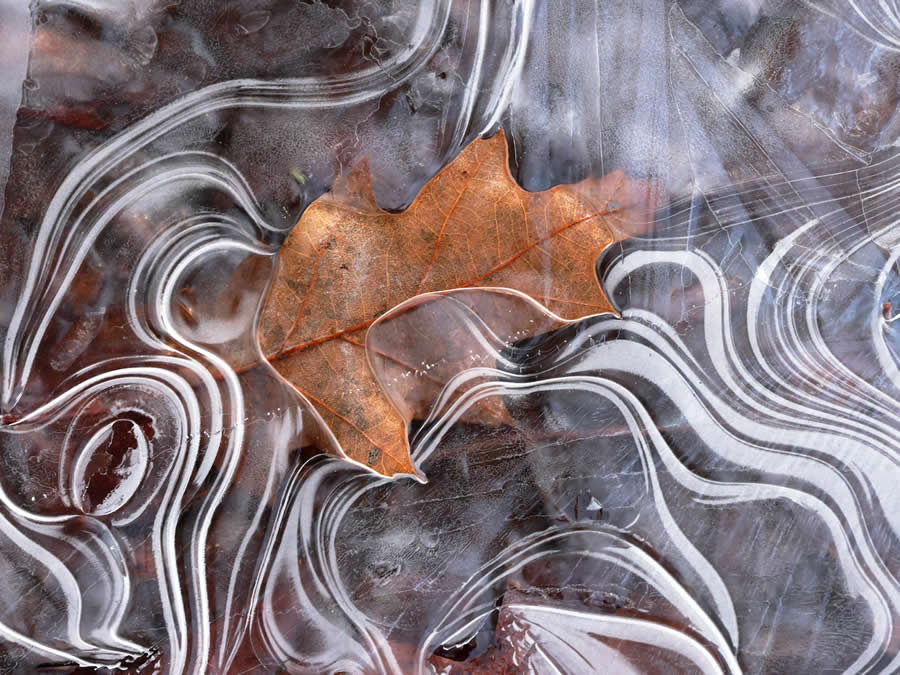
« A dead oak leaf frozen in fragile ice in a woodland pool in Mansfield, Connecticut, USA. Walking along a river on a cold January morning in Connecticut, I had planned to photograph the icy water. Instead, my attention was drawn to swirling patterns of ice in woodland pools away from the river. The ice was unsupported in places where the water had receded and was extremely fragile. I couldn’t step on the edge or even slide a tripod out without it cracking or collapsing. The challenge was to lean out as far as I could over the ice to photograph it from above without breaking anything. I couldn’t compose carefully in that awkward position, so I shot wider and cropped afterwards. »
11. Finalist: « Parasite » by Jacek Hensoldt, Germany
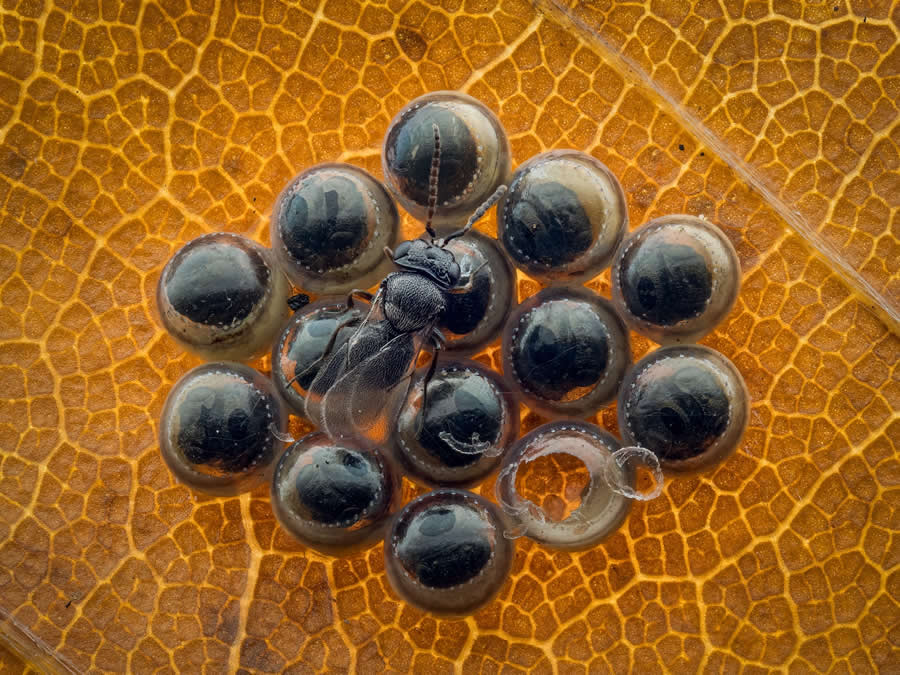
« A cluster of shield bug eggs parasitised by the wasp Trissolcus semistriatus, with one adult emerged and others developing inside the unopened eggs. Photographed in Solingen, Germany. This is a cluster of shield bug eggs parasitised by the wasp Trissolcus semistriatus. The females lay their eggs inside the host eggs, where the larvae feed on the contents – the death of one becoming the prerequisite for the life of another. »
12. Finalist: « Marionette Serenade » by Ken Bluma, USA
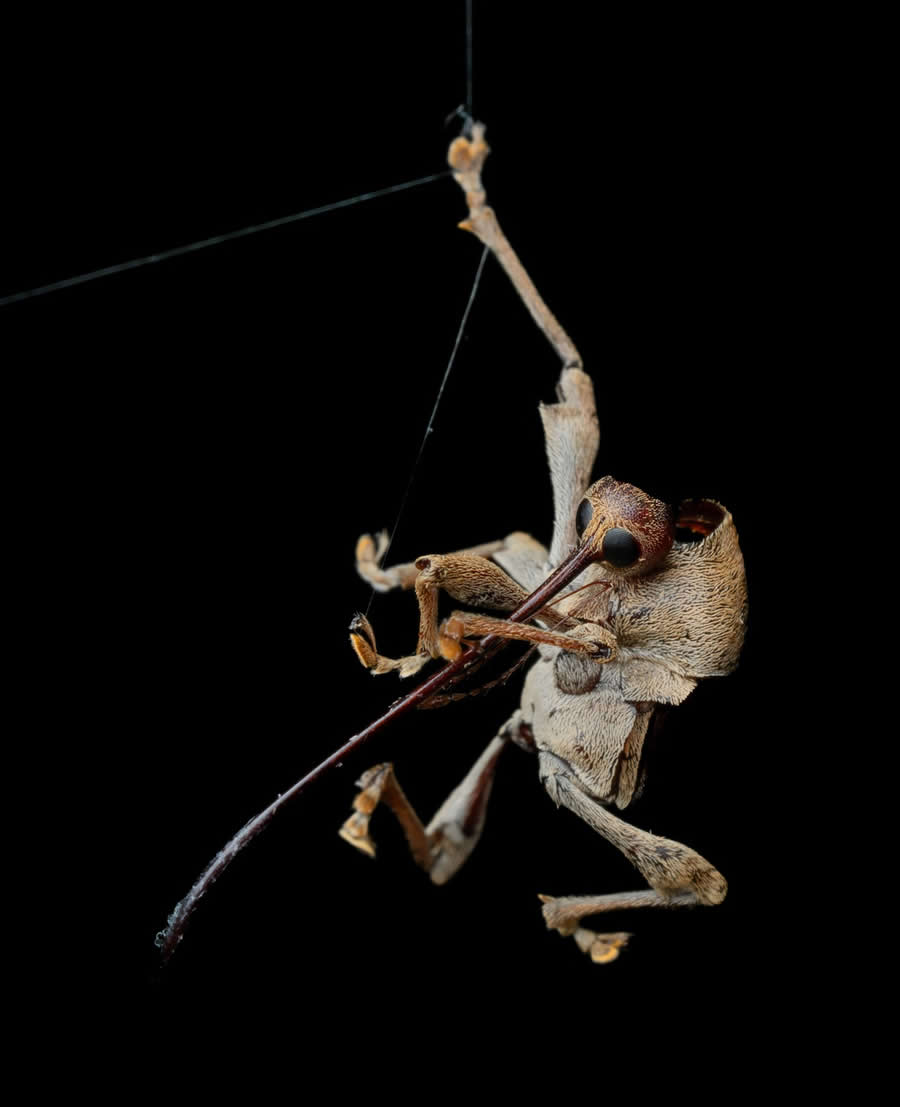
« The hollowed-out exoskeleton of an acorn weevil suspended on a strand of silk in Spring Grove, Illinois, USA. While exploring my local state park in Illinois, I noticed a small object hanging in the vegetation at the edge of the trail. After a closer look, I could see it was an acorn weevil, or rather what remained of one. Looking through the macro lens revealed it had died some time ago and all that was left was its hollowed-out exoskeleton, suspended on a strand of silk. The scene slightly resembled a string puppet performance, the tiny body twirling gently in the breeze. I kept my lighting low, which I felt matched the sombre mood of the scene. »
13. Finalist: « The Souls of the Swamp » by Juan Jesus Gonzalez Ahumada, Spain
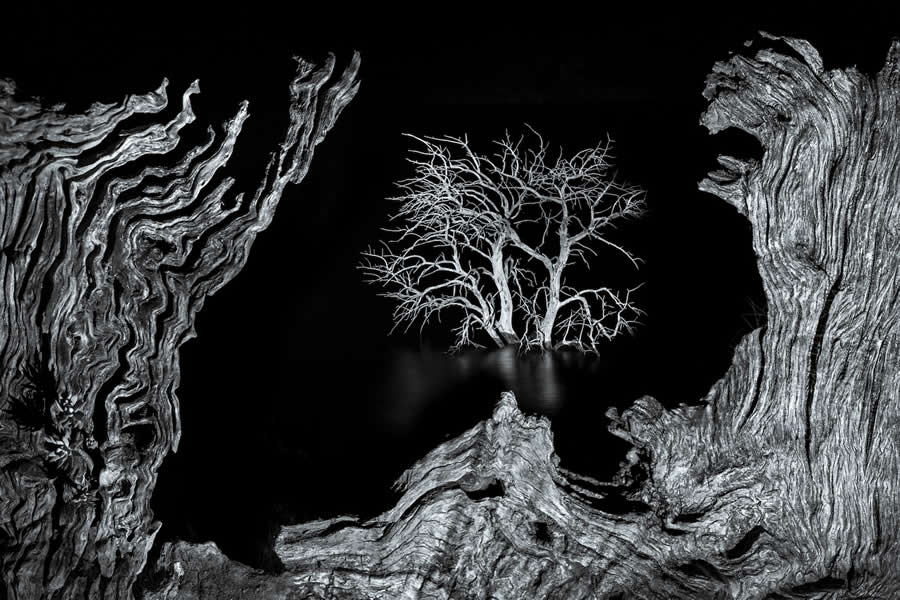
« Dead trees on the edge of the Zahara de la Sierra reservoir, southern Spain, photographed at night using a dual focal-length long-exposure technique. On the edge of the Zahara de la Sierra reservoir in southern Spain, the remains of a fallen tree take on the appearance of a gnarled, talking face. Beyond it, standing in the dark water, another dead tree rises like a ghostly apparition – its counterpart on the shore seemingly praying for its soul. »
14. Finalist: « Mallard in Ice » by Pål Hermansen, Norway
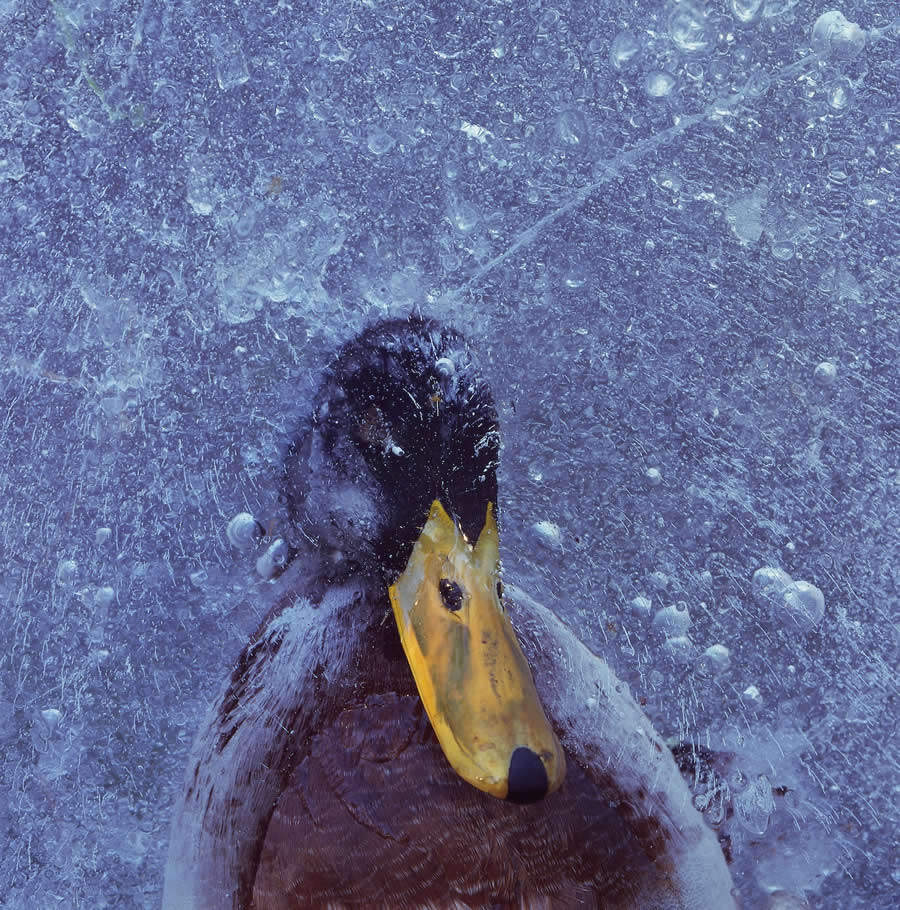
« A dead mallard drake frozen into the ice of a small lake in Follo, Norway. I discovered this dead mallard lying in a small lake that had just frozen over. I realised it could make an interesting image, so I decided to cut out a piece of ice including the bird and take it up onto the bank. There I could make a portrait of the duck, seen from below – the ice acting as a window into death, preserving every feather in perfect detail. »
15. Shortlist: « The Catch » by Pål Hermansen, Norway
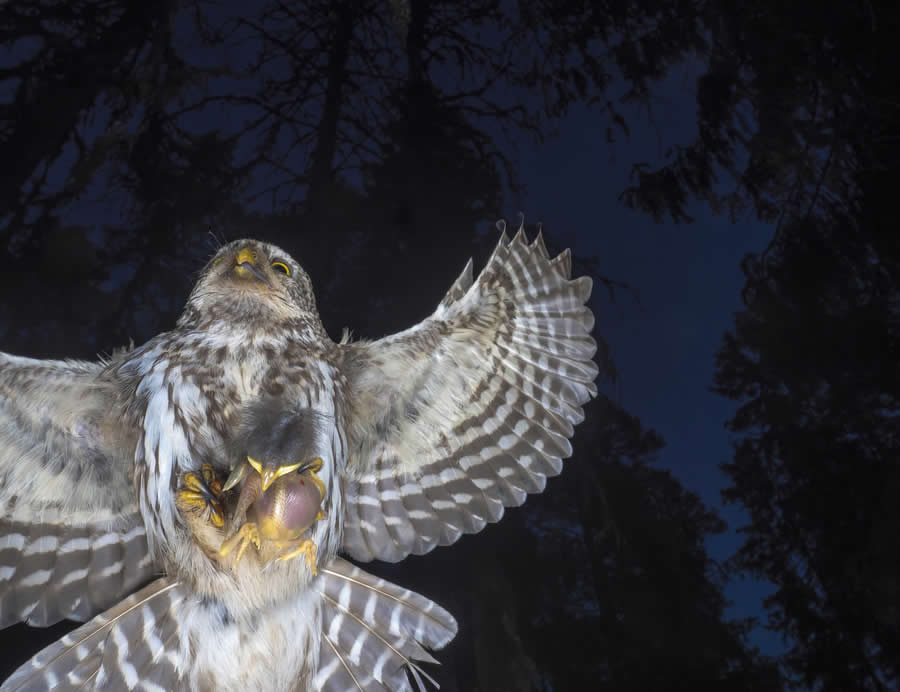
« A pygmy owl (Glaucidium passerinum) carrying prey to its nest, photographed from below in Follo, Norway. I found the nesting site close to my home and decided to try to catch the bird in flight. I noticed it flew from a low position up to the nest, so I positioned a remote camera from below along what I expected to be the flight route. The first night I set up the camera without taking any images, just to be sure the bird was not disturbed. »
16. Shortlist: « Sip Sap Fly » by Indranil Basu Mallick, India
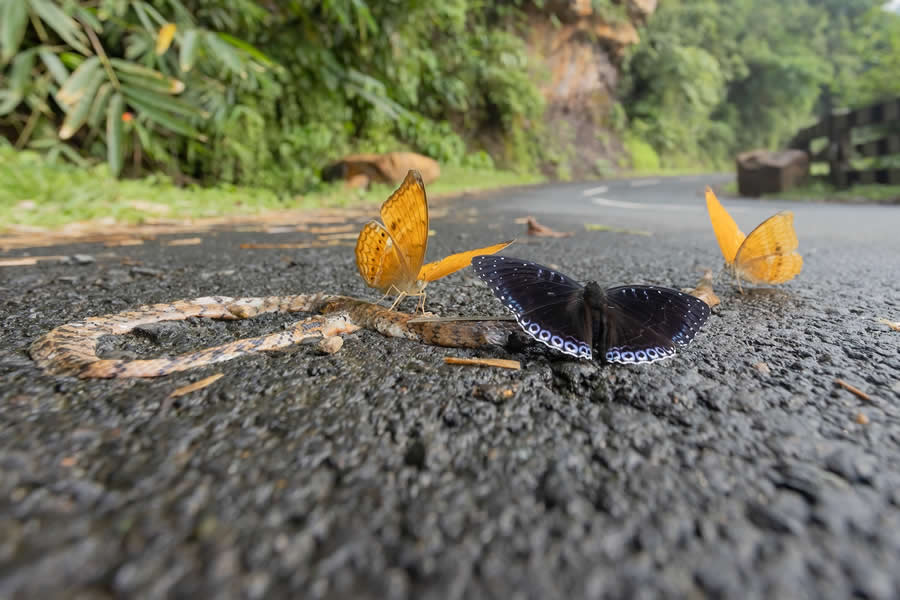
« Butterflies drawing sap and nutrients from a road-killed snake in Cherrapunji, Meghalaya, India. I was on a family trip to Meghalaya and wildlife photography was not my priority, but I had packed my wide-angle and macro lenses just in case. While returning from the Root Bridge at Cherrapunji, I noticed something on the road and quickly pulled over. A snake, tragically run over by a vehicle, had become an unexpected source of life – three vibrant butterflies were intensely drawing moisture and minerals from its body. »
17. Shortlist: « Love is in the Air » by Sophie Mijnhout, Netherlands
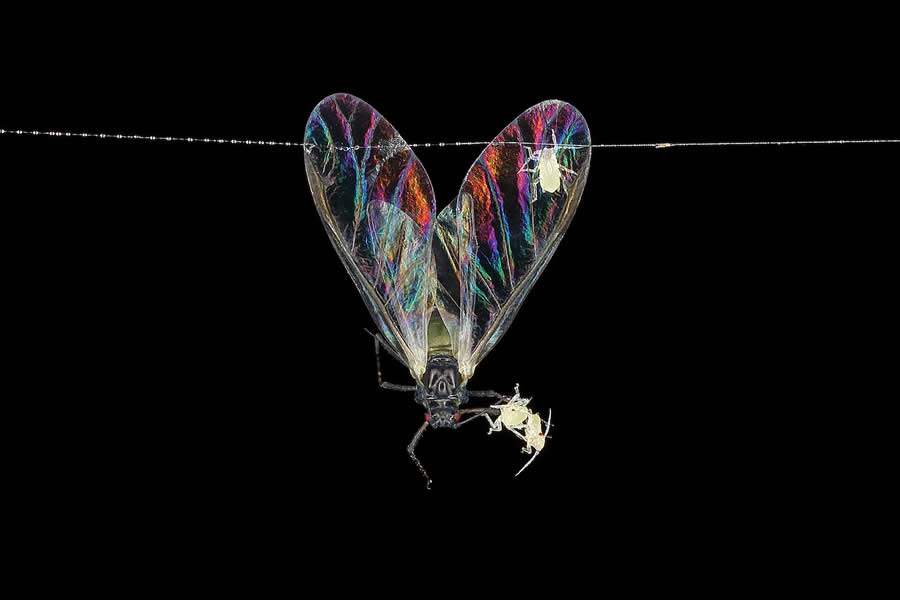
« An aphid gives birth while suspended from a single strand of spider’s web in a garden in Dalfsen, the Netherlands. In the morning, I noticed an aphid hanging from a single strand of a spider’s web, like a piece of laundry on a clothesline. It was too windy to photograph, so I returned in the late afternoon when the air had calmed. The aphid was still alive, but now tiny white specks were clinging to it. Through the macro lens I could see they were baby aphids – the mother had given birth while hanging in mid-air. The little ones, like her, had nowhere to go. A micro-drama that few people will ever have witnessed. »
18. Shortlist: « Is It Cake?! » by Nelson Milano, Puerto Rico
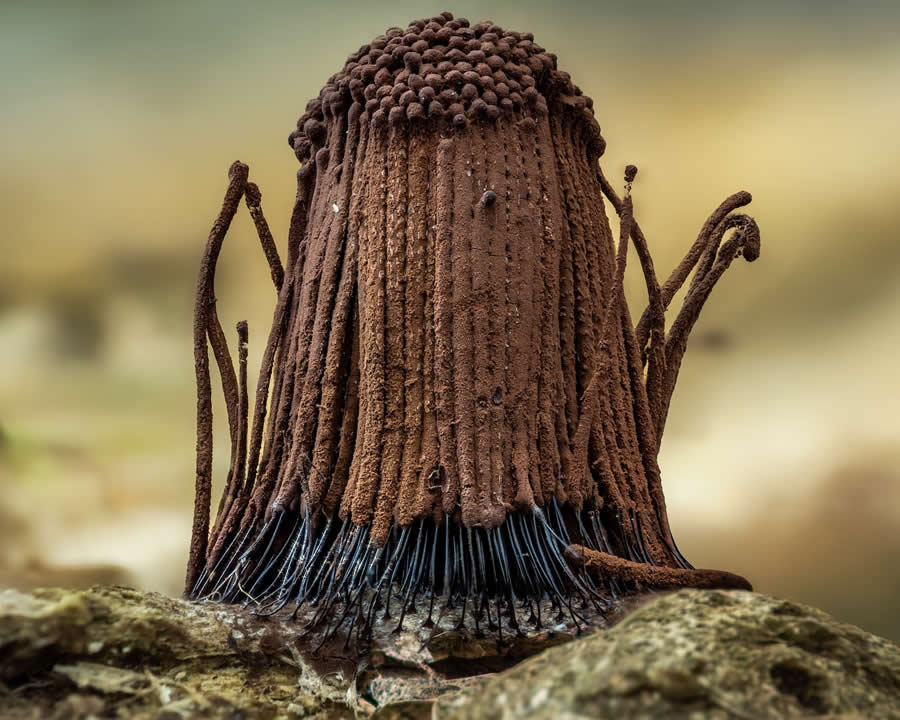
« A chocolate slime mould on a decaying log in Freeport Community Park, Pennsylvania, USA. In my previous job, I used to lead nature walks at a local community park. Nobody was in attendance on that particular day, but I didn’t want to go back to the office and waste a perfectly good summer day, especially as I had my camera. During my walk, I came across a decaying log and on one side found a mass of what I thought looked like chocolate cake. »
19. Shortlist: « Cranefly Entangled in a Sundew » by Ed Phillips, UK
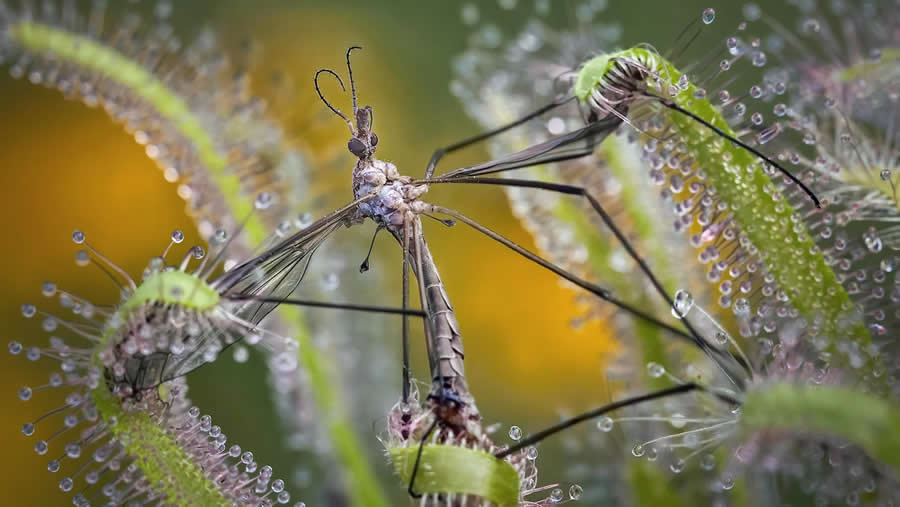
« A cranefly captured by a carnivorous sundew plant in a garden in Staffordshire, England. We have a collection of carnivorous plants in our Staffordshire garden. Lots of craneflies emerge in September and this unfortunate individual had become entangled in one of the sundews (Drosera). I had never seen this before, and haven’t since. The sundew’s specialised leaves had curled around the cranefly, so I assume it had been trapped for some time. It was a remarkable example of the slow, deliberate violence of carnivorous plants. »
20. Shortlist: « Deadly Spikes » by Emanuele Biggi, Italy
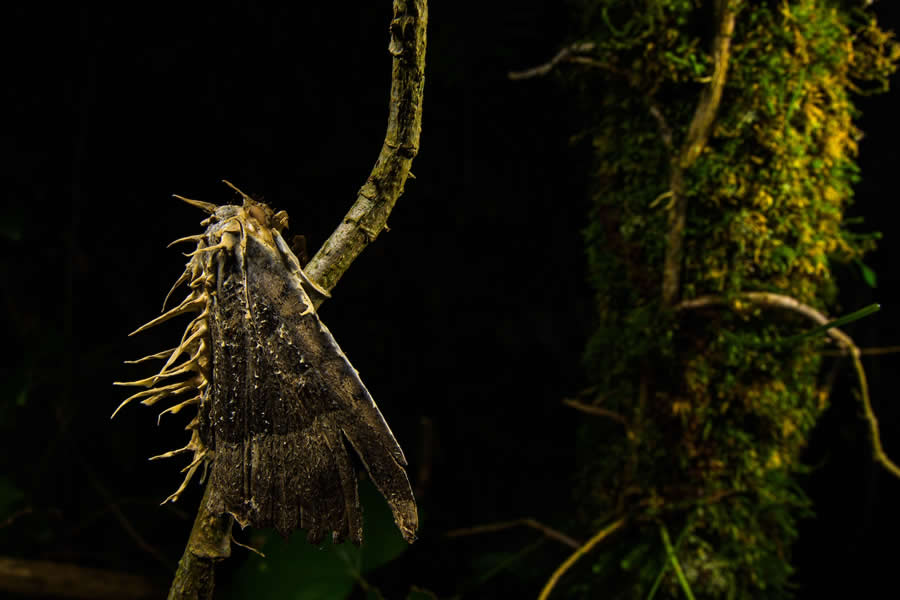
« The fruiting body of an entomopathogenic fungus (probably Acanthomyces sp.) emerging from the dead body of a moth in humid woodland near Licenza, central Italy. I was walking among rocks along a tiny stream lost in the Central Apennines, not far from Rome, when something odd attracted my attention from a nearby bush. Hanging on a stem, a moth had met a gruesome end at the hand of a fungus which had taken over its body and eventually killed the insect. »
FAQs:
What is the CUPOTY Death & Decay Challenge?
The CUPOTY Death & Decay Challenge is a themed photography competition focusing on macro and close-up images that explore natural processes of death, decay, and transformation in the environment through creative storytelling.
Who won the Death & Decay Challenge?
Willem Kruger from South Africa won with his striking image of a hyena carrying a zebra’s head, showcasing the raw, unfiltered reality of nature’s cycle of life and consumption.
Where was the winning image captured?
The winning photograph was taken in Kruger National Park, one of Africa’s most iconic wildlife reserves, known for its diverse ecosystems and powerful predator-prey interactions captured by photographers.
What is Close-up Photographer of the Year (CUPOTY)?
CUPOTY is an international photography competition launched in 2018 that celebrates close-up, macro, and micro photography, inviting photographers worldwide to showcase detailed perspectives of nature and everyday subjects.
When does the CUPOTY competition take place?
The main Close-up Photographer of the Year competition runs annually from May to July, while themed challenges like Death & Decay are held in November, offering additional opportunities for photographers to participate.